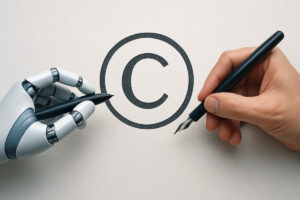
Copyright Office Issues AI Guidance
The Copyright Office issued a guidance report in January on the copyright implications of generative artificial intelligence to clarify concepts that have been vexing creators in recent years. Fortunately, the Office agrees with the majority of us that existing copyright law is sufficient to address questions raised by existing technology and that congressional action therefore is not necessary.
The Fundamental Requirement: Human Authorship
To be eligible for copyright protection, it is axiomatic that a work must be one of human creation. The Supreme Court long ago held in a case captioned Community for Creative Non-Violence v. Reid that an “author” within the meaning of the Copyright Clause of the Constitution and the Copyright Act is a “person who translates an idea into a fixed, tangible expression.” More recently, the Ninth Circuit held in the “monkey selfie” case of Naruto v. Slater that works produced by nature, animals, or plants were not subject to copyright. Though the facts were amusing, the court rejected plaintiffs’ argument that a crested macaque became an author by virtue of taking multiple photographs of himself using a photographer’s camera.
Machines Cannot Be Authors
It follows therefore that a machine cannot be an author. The D.C. Circuit upheld this principle a few weeks ago in Thaler v. Perlmutter, noting that the Copyright Act is replete with references to the lifespan, death, nationality, and intention of authors, none of which could apply to an AI tool.
This is not to say that the use of computer-assisted devices in the creative process, which has been happening for years, will necessarily disqualify a work from copyright eligibility. Photoshop, Pro Tools, and AI assistants that can identify errors in software code are a few examples of non-human interventions that can be used in the creation of ultimately copyrightable works of authorship. AI also can be used in the development of (non-copyrightable) ideas that may then inspire a human author’s (copyrightable) expressive fixation.
The Role of Human Contribution in AI-Generated Works
Still, there are various ways humans may contribute to AI-generated works that bear further analysis and case-by-case determination. The Copyright Office considered three types of AI processes:
- Prompts that instruct an AI system to generate an output;
- Expressive inputs that can be perceived in AI-generated outputs;
- Modifications or arrangements of AI-generated outputs.
Generic Prompts Typically Do Not Qualify for Copyright
Analogizing to settled law concerning joint authorship, the Copyright Office concluded that the mere training or influencing of an AI system by inputting general or generic prompts will in most cases lack enough human creativity and direction to qualify the prompter as an author. Thus, the output would not be subject to copyright.
Not only can the same prompts generate innumerable different outputs that the prompter may not have creatively envisioned, but even developers of AI systems cannot predict or explain their interpretations of prompts or their frequent use of some prompts but not others. As the technology currently exists, users lack actual control over the conversion of an idea into a fixed expression. It is simply a rote, mechanical method of producing something, which the Copyright Act expressly excludes from protection.
When Human Expression Remains in AI Outputs
In contrast, some AI systems can take in a human-author created work and modify it in some way while retaining copyrightable elements that are clearly perceptible in the output. For example, an artist could input an original piece of visual art and ask the system to change the color palette. In that case, the artist may claim authorship in the original work as well as some limited authorship in the altered output, which the Copyright Office may describe in its registration of the work as the “unaltered human pictorial authorship that is clearly perceptible in the deposit and separable from the non-human expression.” See, e.g., Rose Enigma, VAu001528922 (March 21, 2023).
Selection, Modification, and Arrangement of AI Outputs
A third way in which humans may contribute to AI output is by selecting, modifying, arranging, or adapting various pieces of AI-generated output. If the resulting work as a whole reflects sufficient human creativity, the entire work may qualify for protection, although the AI-generated content alone would not.
The factors to consider in any given case would include the creative choices made with respect to the selection, coordination, and arrangement of the AI-generated material. As with a derivative work, the copyright would only protect the content contributed by the human author.
Key Takeaway: Established Principles Still Govern
The important takeaway from the Copyright Office’s report is that, while the court cases on protection of works containing AI-generated materials are emerging, the Register of Copyrights will be looking to established legal principles to determine registration eligibility.